TL;DR
A cable tray BOQ that lists only “cable tray, per metre” is not a specification — it is an invitation to substitute. Every figure that matters to a tender comparison, a load rating, and a corrosion warranty has to be written down, or the cheapest interpretation wins by default.
A complete cable-tray line item pins down nine things: product line (tray / ladder / trunking), perforated or solid, width × depth, material thickness, NEMA load class or working-load requirement, finish per environment, fittings and accessories, maximum support spacing, and delivered lengths. Leave any one of these implied and two bidders can price two different products against the same line — and you cannot compare them.
| Line item | What to write | Why it matters |
|---|---|---|
| Product line | Tray, ladder, or trunking | Sets load behaviour and routing type |
| Perforation | Perforated or solid | Ventilation, derating, EMC |
| Size | Width × depth in mm | Cable fill capacity |
| Thickness | Sheet thickness in mm | Strength and corrosion life |
| Load class | NEMA class or working load | Comparable strength basis |
| Finish | HDG or powder coat, by zone | Corrosion life in the actual environment |
| Fittings | Each bend, tee, reducer by type | The run is mostly fittings |
| Support spacing | Maximum span in mm | Keeps the load rating valid |
| Lengths | Standard delivered lengths | Cutting, jointing, waste |
This guide gives the copy-able checklist, a worked “what to write” example, the misspecifications that recur on Indonesian projects, and how to turn the finished spec into an RFQ.
Why an underspecified BOQ costs you on site
A cable management line that reads “cable tray 200 mm — galvanised — per metre” looks complete. It is not. It does not say perforated or solid, it does not say what thickness of steel, it does not state a load class, it does not say whether “galvanised” means hot-dip or a thin pre-galvanised coil, and it says nothing about fittings or supports. Six bidders can read that line six ways. The lowest number on the page will be the one that read it most cheaply — thin pre-galv coil, the minimum steel that holds shape, fittings priced separately and added later as a variation.
The fix is not more words. It is the right line items, each one pinned to a number or a named standard. The sections below are the items that have to appear, and what to write against each.
The nine line items every cable-tray spec must capture
1. Product line — tray, ladder, or trunking
These are three different systems and they are not interchangeable. State which one each run uses.
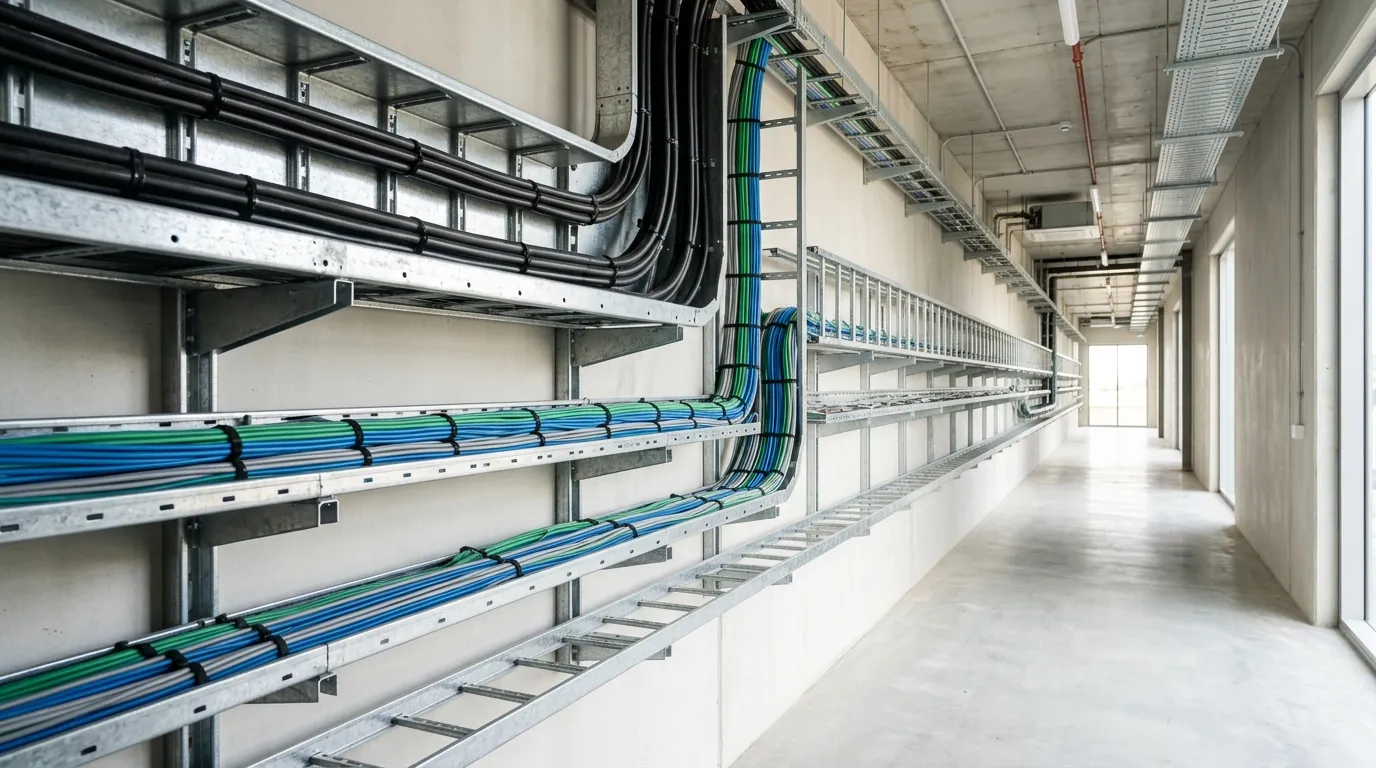
- Cable tray (Metosu TRC perforated / TRU non-perforated) — a U-section trough for power and control cabling on supported horizontal and vertical runs.
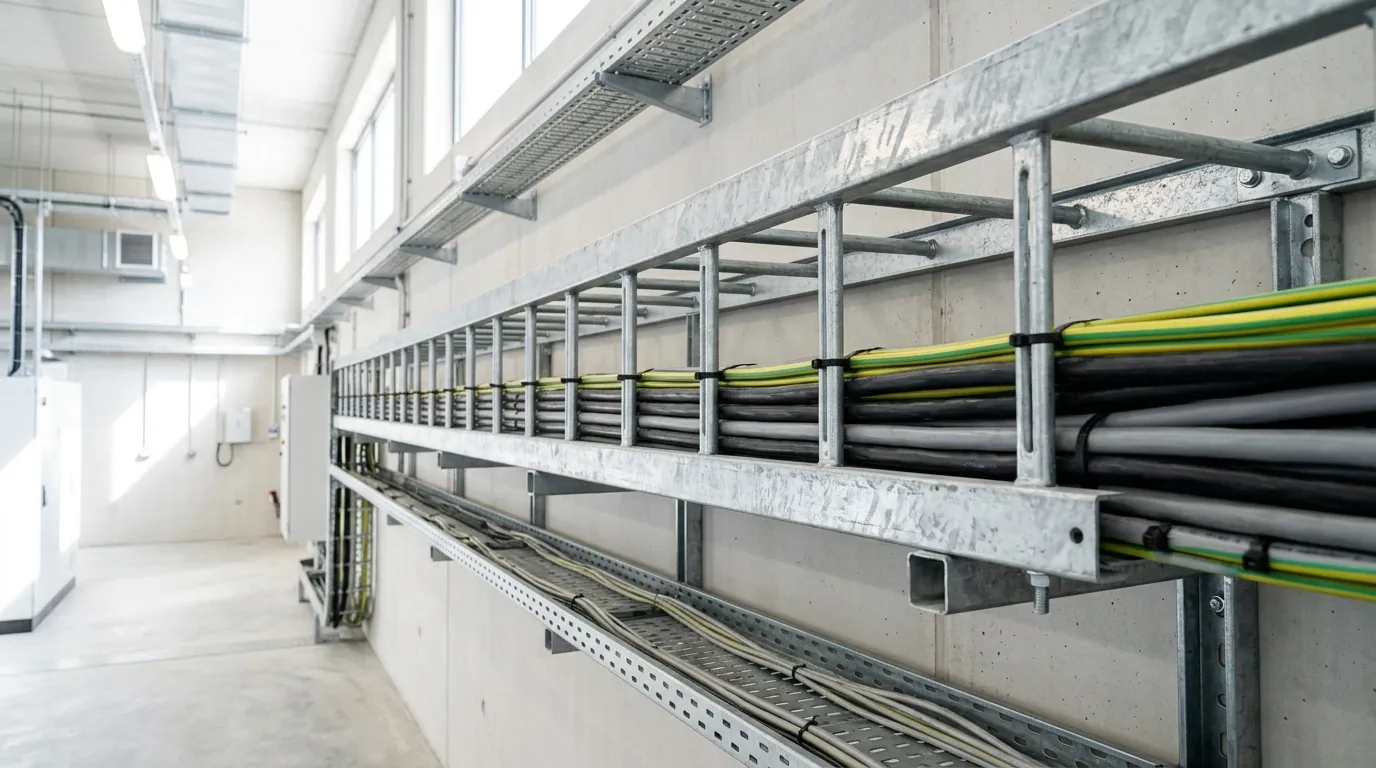
- Cable ladder (SLW perforated / SLU non-perforated) — side rails and rungs for the longest spans and heaviest cable loads.
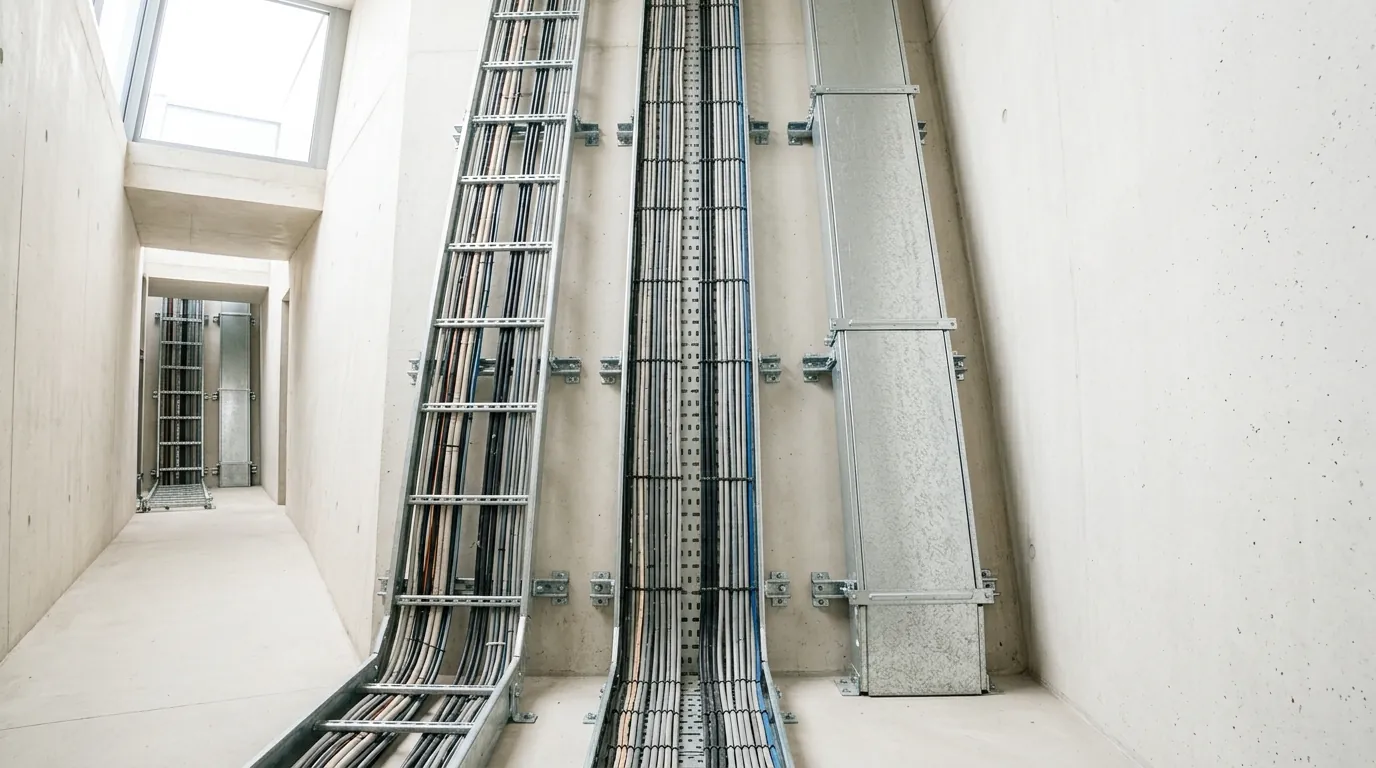
- Cable trunking (TKC perforated cover / TKU solid cover) — an enclosed section with a removable cover for protected routing, small power, and final distribution. Trunking is enclosed routing — it is not deflection-rated, so do not specify it where a load class is the requirement.
See cable ladder vs cable tray for the choice between the first two, and cable trunking — when to enclose for when the third is the right answer.
2. Perforated or solid
State it explicitly per run — do not leave it to the supplier.
- Perforated (TRC / SLW / TKC perforated cover) — the default for most runs. The slots ventilate the cables, which supports thermal derating, and reduce weight.
- Solid / non-perforated (TRU / SLU / TKU solid cover) — for mechanical protection, dust, or where a perforated base is not wanted.
The part-code rule is simple: substitute -SLU for -SLW (and the equivalent for tray and trunking) to switch from perforated to non-perforated. Write the variant you want; do not assume the bidder will read your mind.
3. Width × depth
State both, in millimetres, per run — sized to cable fill with spare capacity for future pulls (see the cable tray sizing guide).
- Cable tray — widths 100–900 mm; depths 50–150 mm.
- Cable ladder — widths 75–1,200 mm; rung spacing 150 mm or 300 mm (state which).
- Cable trunking — widths 100–1000 mm; depths 50–150 mm.
A width without a depth is an incomplete line. Both numbers drive the price and the fill capacity.
4. Material thickness
Sheet thickness is the single most substituted figure on an Indonesian cable-tray tender, because it is invisible once installed and it moves the price directly. State it in millimetres, per size band.
- Cable tray — material 1.0–3.0 mm.
- Cable ladder — material 1.2–3.0 mm.
- Cable trunking — material 1.0–2.5 mm.
Heavier gauge buys both strength and corrosion life — there is more steel to lose before a wall is breached. If the BOQ is silent on thickness, the lowest bid will be the thinnest coil that holds its shape on the rack.
5. NEMA load class — or the working-load requirement
This is how you make strength comparable across bidders. State a NEMA VE 1-2017 load class, or a working load in kg per span at a stated support span. Do not accept “heavy duty” — it is not a defined term.
- Metosu cable ladder (SLW / SLU): independently tested by Sucofindo to a damage load of 1,340 kg per span, NEMA Class 8C (report E26929/FNBPAS).
- Metosu cable tray (TRC / TRU): tested to 420 kg per span, NEMA Class 8B (report E26933/FNBPAS).
Both results are tied to a 2,400 mm support span and a deflection limit of L/250 = 9.6 mm at that span. A load class only means something at the span it was tested at — which is why item 8 (support spacing) belongs in the same specification. Require the test report as a submittal so the class on the datasheet can be checked against a real result, not asserted. See NEMA class vs tested capacity.
6. Finish — specified per environment
The finish is a corrosion decision, and it has to be made zone by zone, not once for the whole project. Metosu’s two standard finishes are:
- Hot-dip galvanised (HDG) to ISO 1461 — the default for plant rooms, external runs, basements, and aggressive or wet environments.
- Jotun powder coat — epoxy-polyester, 60–80 µm, RAL 9010 default, rated ISO 12944 C3 to C5M — for indoor, architectural, or colour-matched runs.
Map the finish to the corrosivity category of each zone and write it against the relevant runs. Do not specify one finish for the whole building when half of it is dry conditioned space and half is a wet plant room. HDG and Jotun powder coat are the only finishes Metosu offers, so the zone map chooses between those two. See HDG vs powder coating.
7. Fittings and accessories — itemised
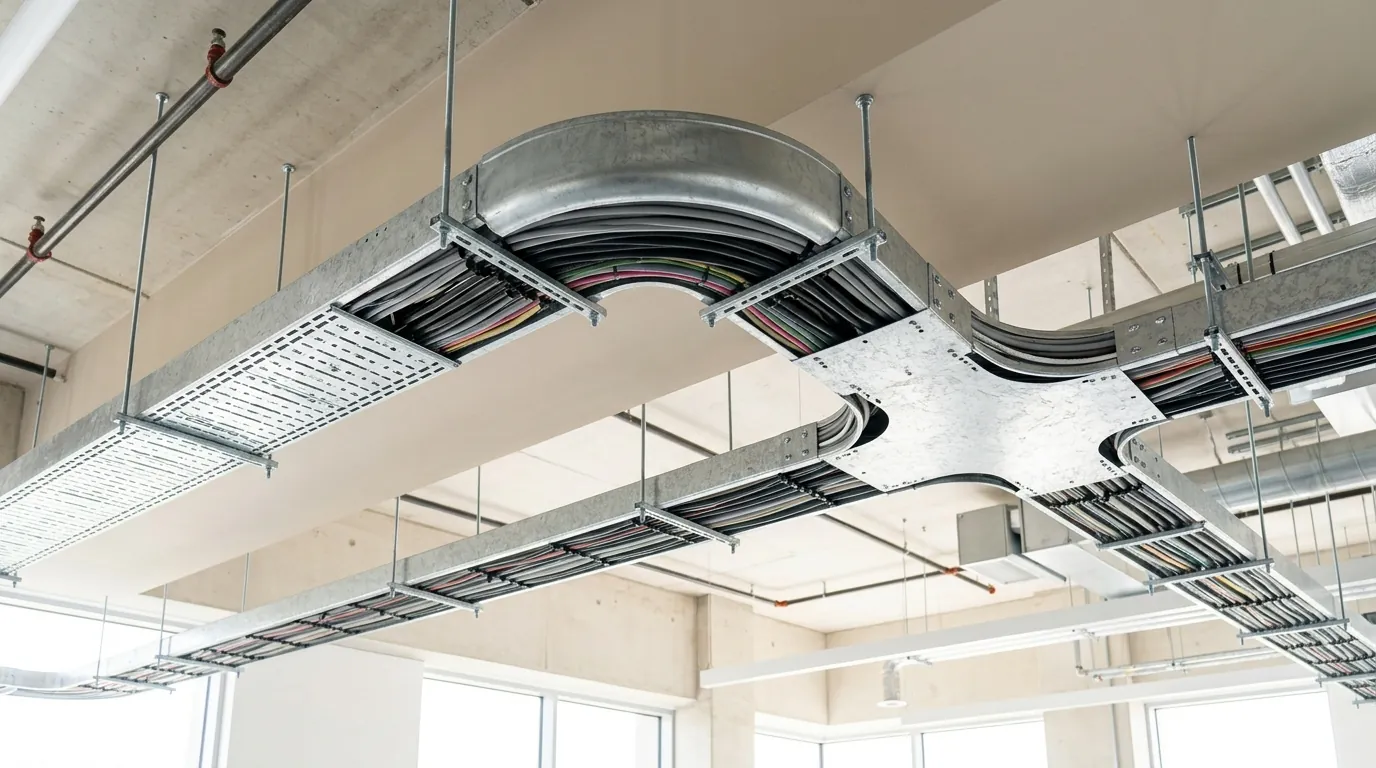
A real run is mostly fittings. A straight-length-only BOQ undercounts the job and leaves every bend as a future variation. Itemise the changes of direction and the accessories.
Fittings (from the catalogue): inside and outside risers, flat-wise elbows, flat-wise cross junctions, equal and unequal tees, and reducers (straight, left-hand, right-hand — all 100 mm height). Count each from the routing drawings, by type and size, and list them as their own lines.
Accessories: hangers, jointing sets, end plates, brackets, clamps, and separators. These are not optional extras — without jointing sets the run does not connect; without separators the segregation you specified elsewhere is not delivered.
8. Maximum support spacing
A load class is only valid at the span it was tested at, so the span has to be in the specification, not left to the installer on the day. State a maximum support spacing in millimetres and require it to sit at or below the manufacturer’s tested span — for Metosu, 2,400 mm. State the deflection limit you require (L/250 or L/100) so the spacing is set against a known target, and call out closer spacing near bends, heavy-fill sections, and vibration as a separate line. Full detail in cable tray support spacing.
9. Delivered lengths
State the standard length so cutting, jointing-set count, and waste can be priced honestly.
- Cable tray — standard lengths 2,400 mm or 3,000 mm.
- Cable ladder — standard lengths 2,400 mm, 3,000 mm, or 6,000 mm.
Longer delivered lengths mean fewer joints per run — fewer jointing sets and less labour — but have to be reconciled with access and handling on site.
A copy-able spec checklist
Use this as the skeleton for each cable-management line in the BOQ. Every row should carry a value, not a blank.
- Product line — tray (TRC/TRU) · ladder (SLW/SLU) · trunking (TKC/TKU)
- Perforation — perforated or solid (state the variant code)
- Width × depth — mm × mm, per run
- Material thickness — mm, per size band
- Load class / working load — NEMA VE 1-2017 class, or kg per span at a stated span
- Finish — HDG to ISO 1461, or powder coat 60–80 µm RAL 9010 (ISO 12944 category) — mapped per zone
- Fittings — risers, elbows, crosses, tees, reducers — counted by type and size
- Accessories — hangers, jointing sets, end plates, brackets, clamps, separators
- Maximum support spacing — mm, at or below the tested span; deflection limit stated
- Delivered lengths — standard length, per product line
- Submittals required — independent load-test report, finish certification, catalogue references
- Standards cited — NEMA VE 1-2017, IEC 61537:2023, IEC 60364-5-52, ISO 1461, ISO 12944, PUIL 2011, SNI
A worked example — what to write
Take a single horizontal power run in a conditioned indoor area. A complete BOQ line reads, in substance:
Cable tray, perforated (Metosu TRC or equal approved), 300 mm wide × 100 mm deep, material thickness 1.5 mm, hot-dip galvanised to ISO 1461. Independently load-tested to NEMA VE 1-2017 Class 8B minimum (≥ 403 kg per span) at a 2,400 mm support span, deflection within L/250; test report by an accredited body to be submitted. Maximum support spacing 2,400 mm, tightened at bends and heavy-fill sections. Supplied in 3,000 mm standard lengths. Includes all fittings (flat-wise elbows, equal and unequal tees, reducers as per routing layout) and accessories (jointing sets, end plates, hangers, separators) — itemised separately in the schedule below.
Compare that to “cable tray 300 mm galvanised, per metre.” The first line can only be priced one way. The second can be priced six ways, and you will spend the tender period — and probably the construction period — finding out which way each bidder chose.
For an architectural run in a dry, visible area, the same line swaps the finish to powder coat, 60–80 µm, RAL 9010, and may switch to solid (TRU) for a cleaner face. The structure of the line does not change — only the values do. That is the point of a checklist-driven spec.
Common misspecifications
These recur on Indonesian projects. Each one is a line item left blank or a term left undefined.
- No thickness stated. The most common and most expensive omission. Without a thickness in millimetres, the lowest bid is the thinnest coil. Always state gauge per size band.
- “Galvanised” with no method. Hot-dip galvanised to ISO 1461 is a different product, and a different corrosion life, from thin pre-galvanised coil. Name the method and the standard.
- One finish for the whole project. A single finish line ignores that a building has dry indoor zones and wet plant rooms with different corrosivity. Map finish to zone.
- A load class with no span. A NEMA class is only valid at the span it was tested at. State the maximum support spacing alongside the class, every time.
- “Heavy duty” instead of a class. Not a defined term. Replace with a NEMA class or a working load in kg per span.
- Trunking specified to a load class. Trunking is enclosed routing, not a deflection-rated structural member. If the run needs a load rating, it is a tray or a ladder.
- Straight lengths only, no fittings. The run is mostly fittings. An un-itemised fittings line becomes a string of variations.
- No test report required as a submittal. A class printed on a datasheet is a claim. A class backed by an accredited report is evidence. Require the report.
Turning the spec into an RFQ
Once each line carries its nine values, the BOQ is already most of an RFQ. To send it for quotation:
- Group runs by product line and finish — all HDG perforated tray together, all powder-coat together — so the supplier can price by batch.
- Attach the fittings and accessories schedule, counted from the routing drawings, alongside the straight-length quantities.
- List the required submittals — independent load-test report, finish certification, catalogue references — so the quote comes back comparable, not just cheap.
- State the cost drivers you are open on — width, thickness, finish, fittings count, and order volume all move the number, and a supplier who can see the whole package can quote it sharply.
- Send it. Email the schedule to
[email protected]or use the RFQ form, and Metosu’s engineering team will quote against your line items — and flag any that are still ambiguous before they reach site.
A specification written to this checklist does two things: it makes bids comparable, and it makes substitution visible. Both are worth far more than the words they cost.
Further reading
- Cable tray sizing guide — sizing width and depth for cable fill and future capacity
- Cable tray support spacing — the span that keeps a load class valid
- NEMA class vs tested capacity — verifying a real load rating
- HDG vs powder coating — choosing the finish per environment
- Cable ladder vs cable tray — choosing the right system for the run
- Cable tray · Cable ladder · Cable trunking · All products · Full catalogue (PDF)