TL;DR
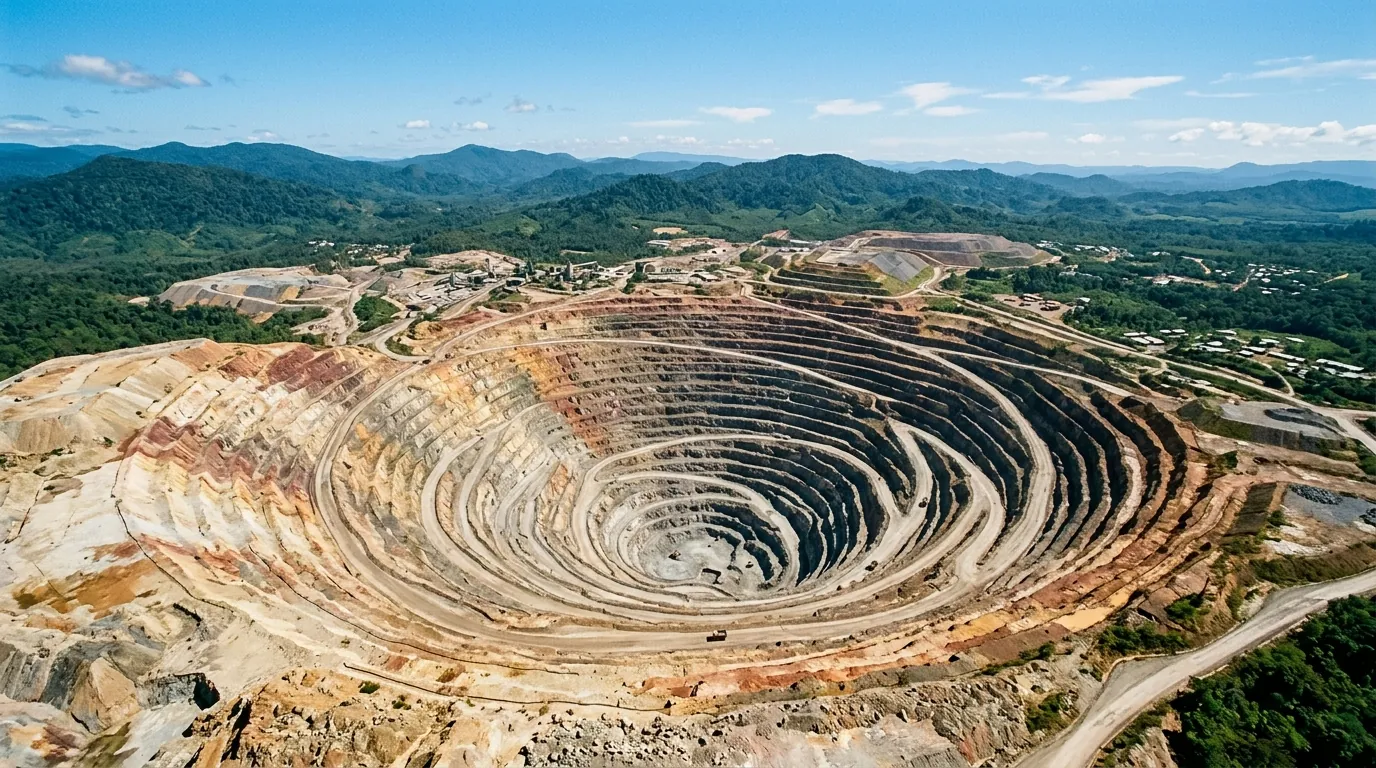
Mining and mineral processing are the harshest containment environments Indonesia builds. Long cable runs, heavy power feeders, abrasive dust, constant vibration, wash-down, and — near coastal smelters and nickel HPAL plants — corrosive process atmospheres. The default selection is heavy-duty cable ladder, not tray, in a galvanised finish, with support spacing set against the real load.
| The condition | What to specify |
|---|---|
| Long runs of heavy power feeders | Cable ladder (SLW/SLU) — NEMA Class 8C, 1,340 kg/span |
| Lighter instrument/control runs | Cable tray (TRC/TRU) — NEMA Class 8B, 420 kg/span |
| Outdoor, dust, wash-down | Hot-dip galvanised to ISO 1461 |
| Coastal smelter / H₂S / chloride atmosphere | Corrosion-class thinking per ISO 12944 (C4–C5M) |
| Vibration, heavy fill | Tighten support spacing below the 2,400 mm tested span |
Metosu’s ladder and tray systems are engineered for and suitable for mining and mineral-processing duty. The rest of this post is the spec logic — load class, finish, corrosion class, and support spacing — for getting it right.
Why ladder, not tray, is the mining default
Most mining electrical reticulation is dominated by heavy power feeders running long distances — from substations to crushers, mills, pumps, conveyors, and process plant. These are large-diameter, high-mass conductors, and the runs are long and repeating. That combination points to cable ladder.
Metosu’s cable ladder line — SLW (perforated side rail) and SLU (non-perforated) — is the heavy-duty selection:
- Load capacity: 1,340 kg/span, independently tested by Sucofindo (report E26929/FNBPAS, 14 July 2025) to NEMA VE 1-2017 — NEMA Class 8C, the highest working-load class. That is 2.5× the Class 8C minimum of 534.4 kg, measured at a 2,400 mm support span.
- Deflection: verified to L/250 = 9.6 mm at the 2,400 mm span — 2.5× tighter than NEMA VE 1’s own L/100 (24 mm) working-load limit.
- Widths: 75–1,200 mm; rung spacing 150 or 300 mm; lengths 2,400, 3,000, and 6,000 mm; steel 1.2–3.0 mm.
The open-rung geometry matters in mining. It lets heat from heavily loaded power feeders escape by convection — power cables derate in enclosed channels — and it lets dust and wash-down water fall through rather than collecting in the base. A solid-base tray loaded with heavy feeders in a dusty plant becomes a tray full of conductive sludge.
Cable tray (TRC perforated / TRU non-perforated, NEMA Class 8B, 420 kg/span, Sucofindo report E26933/FNBPAS) still has a place — for lighter instrument, control, and LV distribution where the cable mass is modest and a managed, contained route is wanted. But for the long heavy-feeder spine of a mine or processing plant, ladder is the correct category. See cable ladder vs cable tray for the full decision logic.
When ladder beats tray — the rule:
If the run carries heavy power feeders over long spans, or sits where dust and wash-down would collect in a solid base, specify cable ladder. Reserve cable tray for lighter control and instrument runs.
Finish: galvanised for outdoor and corrosive duty
Mining containment lives outdoors, in dust, under wash-down, and for a decade or more. The finish is not cosmetic — it is the corrosion barrier the system depends on.
Metosu offers two standard finishes:
- Hot-dip galvanised (HDG) to ISO 1461 — the default for mining. The zinc coating is applied by full immersion after fabrication, so cut edges, welds, and internal surfaces are all protected. This is the right finish for outdoor reticulation, dusty plant, and wash-down areas.
- Jotun powder coat — an AS epoxy-polyester hybrid at 60–80 µm dry film, RAL 9010 default, rated C3–C5M corrosion class per ISO 12944 and holding >50% gloss retention after 1,000 h of ISO 11507 QUV exposure. Used where colour identification or a finished surface is wanted, applied over a galvanised substrate.
For most mining duty, HDG to ISO 1461 is the specification. It handles abrasion, dust, and wash-down, and the immersion process protects the whole part rather than just the visible faces — which matters when a tray rail is being abraded by airborne mineral dust.
For finish-selection logic across environments, see HDG vs powder coating.
Corrosion-class thinking for processing atmospheres
Galvanising is the right starting point, but not every mining atmosphere is the same, and the specification should be set against a corrosion class, not a habit. ISO 12944 classifies atmospheric corrosivity from C1 (benign indoor) to CX (extreme offshore/industrial). The processing end of mining pushes high up that scale:
| Environment | Typical ISO 12944 class | What drives it |
|---|---|---|
| Open-pit, dry, inland | C2–C3 | Dust, weather, UV |
| Coal handling, humid plant | C3–C4 | Humidity, wash-down, dust |
| Nickel HPAL / process plant | C4–C5 | Acidic process atmosphere, humidity |
| Coastal smelter | C4–C5M | Chlorides (marine) + SO₂/H₂S (smelter off-gas) |
The combination that bites hardest in Indonesia is the coastal smelter and HPAL setting: a marine chloride load from the sea air plus sulphur compounds (SO₂, H₂S) from smelter off-gas or acidic process streams. That is genuine C5M territory.
The corrosion-class rules:
- Establish the corrosion class first. Survey the actual atmosphere — coastal proximity, process off-gas, wash-down chemistry — and assign an ISO 12944 class before selecting a finish.
- C2–C4, outdoor mining duty: HDG to ISO 1461 is the specification.
- C5/C5M, coastal smelter or aggressive HPAL atmosphere: treat the finish as a design decision, not a default. HDG remains the base; where the atmosphere reaches the upper end of the scale, discuss a duplex (HDG + Jotun powder coat, which is rated to C5M) with the engineering team. For the most extreme process atmospheres, treat the finish as an engineering review, not a catalogue pick.
The point is to match the finish to the measured atmosphere, and to write that atmosphere — not just “galvanised” — into the specification.
Support spacing under heavy load
Mining feeders are heavy, and mining plant vibrates. Both attack the load rating through the same mechanism: support spacing.
A load class is only valid at the span it was tested at. Metosu’s 1,340 kg ladder result is measured at a 2,400 mm support span. Treat that as a ceiling, not a target:
- Heavy fill → tighten spacing. A ladder carrying a dense bundle of large power feeders is near the load the span was tested for. Bring supports in below 2,400 mm to keep margin.
- Vibration → tighten spacing. Crushers, mills, conveyors, and pumps add dynamic load a static rating does not account for. In vibrating plant, reduce spacing and treat vibration as a design input.
- Bends and fittings → add support. Place a support close to each bend, tee, and reducer rather than relying on straight-run spacing.
| If the run is… | Then specify support spacing… |
|---|---|
| Light control/instrument, steady plant | At or below the 2,400 mm tested span |
| Heavy power feeders, high fill | Below 2,400 mm — e.g. 1,800 mm |
| Adjacent to vibrating plant (crusher, mill, pump) | Tighter still, vibration as a design case |
| Across a bend or fitting | Support immediately adjacent to the fitting |
For the full method — including how deflection rises far faster than span, and how to write spacing into a BOQ — see cable tray support spacing and NEMA VE 1 load classes explained.
A concrete spec checklist for mining
Pulling it together — the rules to write into a mining or mineral-processing specification:
- Heavy power feeders, long runs: cable ladder (SLW/SLU), NEMA Class 8C, 1,340 kg/span.
- Light control/instrument runs: cable tray (TRC/TRU), NEMA Class 8B, 420 kg/span.
- Finish, standard outdoor mining duty: hot-dip galvanised to ISO 1461.
- Finish, C5/C5M coastal smelter or HPAL atmosphere: establish the ISO 12944 class, then specify accordingly — duplex HDG + Jotun powder coat at the aggressive end.
- Support spacing: at or below the 2,400 mm tested span; tighter under heavy fill and vibration.
- State the atmosphere and the spacing explicitly in the BOQ — do not leave them implied by a class letter.
- Require the test reports as submittals: Sucofindo E26929/FNBPAS (ladder) and E26933/FNBPAS (tray).
Engineered for mining — talk to engineering
Metosu manufactures cable ladder, tray, and trunking in Tangerang from hot-rolled mild steel, and its heavy-duty Class 8C ladder is engineered for the load, abrasion, and corrosion duty that mining and mineral processing demand. For a specification review against a specific atmosphere, load case, or finish, send the cable schedule and a typical section drawing to [email protected] or contact the Metosu technical team.
Further reading
- Mining industry page — heavy specification for coal, copper, nickel
- Cable ladder · Cable tray — product detail and dimensions
- NEMA VE 1 load classes explained — what 8A, 8B, and 8C mean
- Cable tray support spacing — the span that decides your real load rating
- HDG vs powder coating — choosing a finish for the environment
- Catalogue (EN) · Catalogue (ID)
- ISO 12944 — atmospheric corrosivity classification cited above
- NEMA VE 1-2017 — cable tray load classification standard