TL;DR
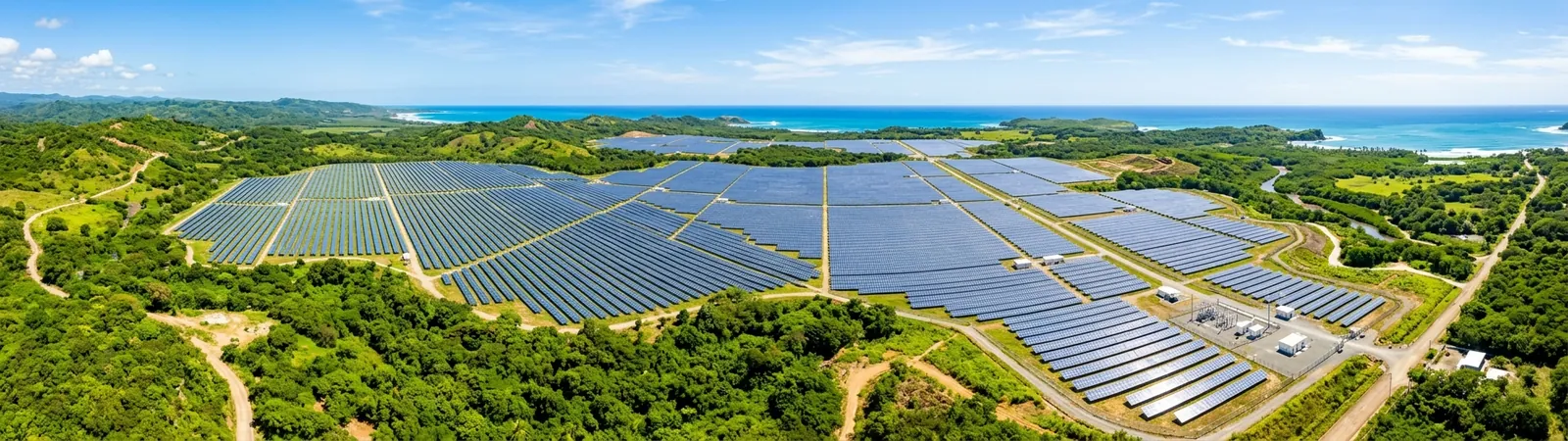
Cable management for a utility-scale solar (PLTS) plant in Indonesia is an outdoor specification, and that changes almost every decision. The trays and ladders sit in full sun, cycle through a wide daily temperature swing, and — on the coastal and high-humidity sites where much of Indonesia’s PV capacity is built — face a chloride and moisture corrosion load that an indoor commercial system never sees.
A galvanised heavy-duty steel system handles this set of stresses where polymer trays cannot. Steel does not embrittle under UV, it holds long outdoor support spans, and it can be specified to a defined corrosion class. The two decisions that carry the most weight are the finish — matched to an ISO 12944 corrosion class for the actual site — and the thermal derating of bunched DC string cables running in the open sun.
| The outdoor stress | What it forces in the specification |
|---|---|
| UV and decades of sunlight | Steel, not polymer — UV does not embrittle a galvanised steel system |
| Daily thermal cycling | Expansion gaps and fixings that tolerate movement |
| Coastal / humid corrosion | Finish matched to the ISO 12944 corrosion class (C3–C5M) for the site |
| Long spans between supports | A tested heavy-duty load class, verified at the span you install |
| Bunched DC strings in open sun | Thermal derating at a higher ambient, per IEC 60364-5-52 |
Metosu is an Indonesian cable-management manufacturer (PT Metalindo Tosan Surya, established 1984, factory in Tangerang). Its cable tray and cable ladder are engineered for, and suitable for, this outdoor PV duty — heavy-duty galvanised steel sections with finishes selectable per ISO 12944. This guide sets out the decision rules an engineer can act on.
Why a galvanised heavy-duty steel system
Outdoor PV cable routing is a long-life structural problem in an aggressive environment. Three properties decide whether a system survives it.
UV stability. A PV plant is, by definition, in the sun all day for its entire operating life — 25 years or more. Polymer and GRP trays degrade under sustained UV: the surface chalks, the material embrittles, and mechanical strength falls away over time. Hot-rolled mild steel, hot-dip galvanised, does not have that failure mode. UV does not weaken the steel or its zinc coating, so the structural rating you specify on day one is the rating you keep.
Thermal tolerance. Open-field steel in Indonesian sun moves through a wide daily temperature range — cool at dawn, hot under midday irradiance. Steel expands and contracts predictably, and a steel system is detailed for it with expansion gaps and fixings that allow movement. The concern with thermal cycling is not the steel; it is the joints and the coating, which is why finish and detailing matter as much as the section.
Load at long spans. Outdoor runs across a PV field carry power cable and string cable over support spacings set by the racking and the trench layout — often wider than an indoor building would use. That calls for a tested heavy-duty load class, not a light commercial tray. Metosu’s cable ladder (SLW perforated / SLU non-perforated) is NEMA Class 8C, independently tested by Sucofindo to 1,340 kg per span at a 2,400 mm support span (report E26929/FNBPAS) — 2.5× the Class 8C minimum of 534.4 kg. The cable tray (TRC perforated / TRU non-perforated) is NEMA Class 8B, tested to 420 kg per span at the same 2,400 mm span (report E26933/FNBPAS), against the Class 8B minimum of 403 kg. Both were verified against a deflection limit of L/250 — 9.6 mm at the 2,400 mm span — which is stricter than NEMA VE 1’s own L/100 (24 mm) limit.
For a PV plant, the ladder is usually the primary system for the heavier power-cable trunk routes, and perforated tray for the string-cable collection routes — the perforations also help the bunched DC cables shed heat, which the derating section below depends on.
Corrosion class: select the finish for the site, per ISO 12944
This is the decision that most often gets under-specified on an outdoor PV plant, and it is the one with the longest tail. The right way to set it is to classify the site’s atmospheric corrosivity under ISO 12944 and then select the finish to match.
Indonesian PV sites span a wide corrosivity range:
- Inland, drier sites sit around C3 — moderate corrosivity, urban or rural atmospheres with some pollution.
- Humid inland and light-industrial sites push toward C4 — high corrosivity.
- Coastal and offshore-adjacent sites — a large share of Indonesia’s land-constrained PV capacity — reach C5M, the marine high-corrosivity class, driven by airborne chloride.
Metosu offers two standard finishes, and the selection rule is straightforward:
| Site corrosion class (ISO 12944) | Typical environment | Specify |
|---|---|---|
| C3 | Inland, moderate, low-chloride | Hot-dip galvanised to ISO 1461 |
| C4 | Humid inland / light-industrial | HDG to ISO 1461, or Jotun powder coat where a C4+ rating or colour is required |
| C5M | Coastal, marine, high chloride | Jotun powder coat — the C5M-rated finish |
Hot-dip galvanised to ISO 1461 is the galvanised baseline for the drier, lower-chloride inland sites. It is a robust, well-understood outdoor finish and the default for most non-coastal PV routing.
Jotun powder coat is the finish to specify where the site classifies higher. It is a Jotun AS epoxy-polyester hybrid applied at a 60–80 µm build, rated C3–C5M per ISO 12944 — so it is the explicitly rated option for the coastal C5M case. It also holds colour and gloss: more than 50% gloss retention after 1,000 hours of ISO 11507 QUV exposure, RAL 9010 as the default colour. For a coastal PV plant, this is the finish that carries a defensible corrosion class on paper.
For the most extreme chloride environments — splash-zone or offshore structures beyond C5M — the finish becomes an engineering review rather than a catalogue pick; for utility-scale onshore PV in Indonesia, the ISO 12944 class almost always lands inside the C3–C5M range that the two standard finishes cover.
The decision rule: classify the site under ISO 12944 first, then pick the finish to the class — do not default every site to one finish. A coastal plant specified in the inland finish will show coating breakdown years before end of life; an inland plant specified for marine duty is paying for corrosion class it does not need.
Thermal derating: bunched DC strings in open sun
A PV plant has a thermal load case that an indoor installation does not: long runs of DC string cable, often bunched together, sitting in direct sun. Two effects stack.
The ambient is higher. Cable ampacity is quoted at a reference ambient temperature. A tray of cables in open Indonesian sun runs at an ambient well above that reference — the sun heats the cables and the tray directly. The base ampacity has to be corrected down for the real ambient before anything else is applied.
The cables are grouped. DC strings collected onto a tray are bunched, and a bunched cable runs hotter than a single cable in free air because its neighbours are also heat sources and its escape routes are blocked. That calls for a grouping correction factor on top of the ambient correction.
Both corrections come from IEC 60364-5-52, with PUIL 2011 governing the installation in Indonesia. Skip either one and the string cable is under-sized for the conditions it actually runs in — it ages faster and the problem surfaces years after commissioning. The full mechanism, and the rules for keeping cables to a single layer and spacing rather than bundling, are worked through in the companion post on thermal derating in cable trays.
The system choice helps here. A perforated tray (TRC) or an open-rung cable ladder (SLW/SLU) lets air move around and beneath the bunched strings, so the grouping penalty is smaller than it would be in a solid-base tray or an enclosed trunking. For DC string collection in open sun, the open systems are the thermal default.
Support spans outdoors
Outdoor runs are often supported off the PV racking or off dedicated posts, at spacings set by the field layout rather than by a building’s structural grid — which can mean wider spans than an indoor route. A load class is only valid at the span it was tested at: Metosu’s 1,340 kg ladder and 420 kg tray figures are measured at a 2,400 mm support span, against the L/250 — 9.6 mm deflection limit. Hold the installed support spacing at or below the tested span, and tighten it near heavy cable-fill sections, bends, and any wind-exposed runs. The full span-versus-rating logic is in the companion post on cable tray support spacing.
Decision rules for a PV plant specification
- Specify steel, not polymer, for the outdoor runs. A galvanised heavy-duty steel system does not embrittle under decades of UV and holds the load class you specify.
- Classify the site under ISO 12944, then choose the finish to the class. C3 inland → HDG to ISO 1461. C5M coastal → Jotun powder coat, the C5M-rated finish. Do not default every site to one finish.
- Use the ladder for heavy power trunk routes, perforated tray for DC string collection. The open systems also help the bunched strings shed heat.
- Derate the DC string cables for both the higher outdoor ambient and the grouping, per IEC 60364-5-52 and PUIL 2011. Both corrections, not one.
- Hold support spacing at or below the tested span (2,400 mm), and tighten it near heavy fill, bends, and wind-exposed runs.
Talk to the Metosu engineering team
Metosu’s cable tray and cable ladder are engineered for outdoor utility-scale PV duty in Indonesia — heavy-duty galvanised steel, with finishes selectable to the site’s ISO 12944 corrosion class. If you are writing a cable management specification for a PLTS project and want the finish, span, and derating decisions worked through for your site conditions before the BOQ is locked, email [email protected] or contact the Metosu team.
Further reading
- Clean energy & solar capability — cable management engineered for the PV sector
- Cable tray thermal derating — why bunched cables carry less current
- Cable tray support spacing — the span that decides the real load rating
- Cable tray · Cable ladder · Full catalogue (PDF)