If you are a procurement lead or DC contractor sourcing manager in Singapore, you have probably run through the same mental shortlist: China, Malaysia, Vietnam, Indonesia. Each origin has a different risk-reward profile — cost, lead time, logistics friction, quality floor, and geopolitical exposure. This guide focuses specifically on Indonesia, and specifically on what it takes to qualify an Indonesian manufacturer, move product through Tanjung Priok to PSA, and land compliant cable management on a Singapore job site. It is written for buyers who need a defensible decision pack, not a marketing brochure.
Why Indonesia Is Worth Looking At Seriously
ATIGA removes the import duty. Under the ASEAN Trade in Goods Agreement (ATIGA), cable management products manufactured in Indonesia with sufficient ASEAN content (typically ≥ 40% ASEAN value-added) enter Singapore at 0% import duty. The same product shipped from China pays Singapore’s standard MFN tariff — usually 0% already for cable trays under HS Chapter 73, but the ATIGA preference also locks in preferential treatment as trade rules shift. More practically, it means your landed cost calculation does not carry a tariff variable that can move with geopolitical events. Indonesia-manufactured product is structurally cheaper to land in Singapore than China-manufactured product if the supplier can certify ATIGA origin with a Form D certificate.
Shipping is shorter and simpler. Tanjung Priok (Jakarta’s main container port) to PSA Singapore is roughly 3–5 transit days by feeder vessel. China’s main export ports (Ningbo, Shanghai) are 10–16 days. That gap narrows your reorder horizon and reduces the capital you have to tie up in safety stock. Operationally, an ASEAN-to-ASEAN short-sea move also has simpler customs documentation than a long-haul China import — bilateral ATA, combined ATIGA Form D, and standard SIRIM-equivalent declarations.
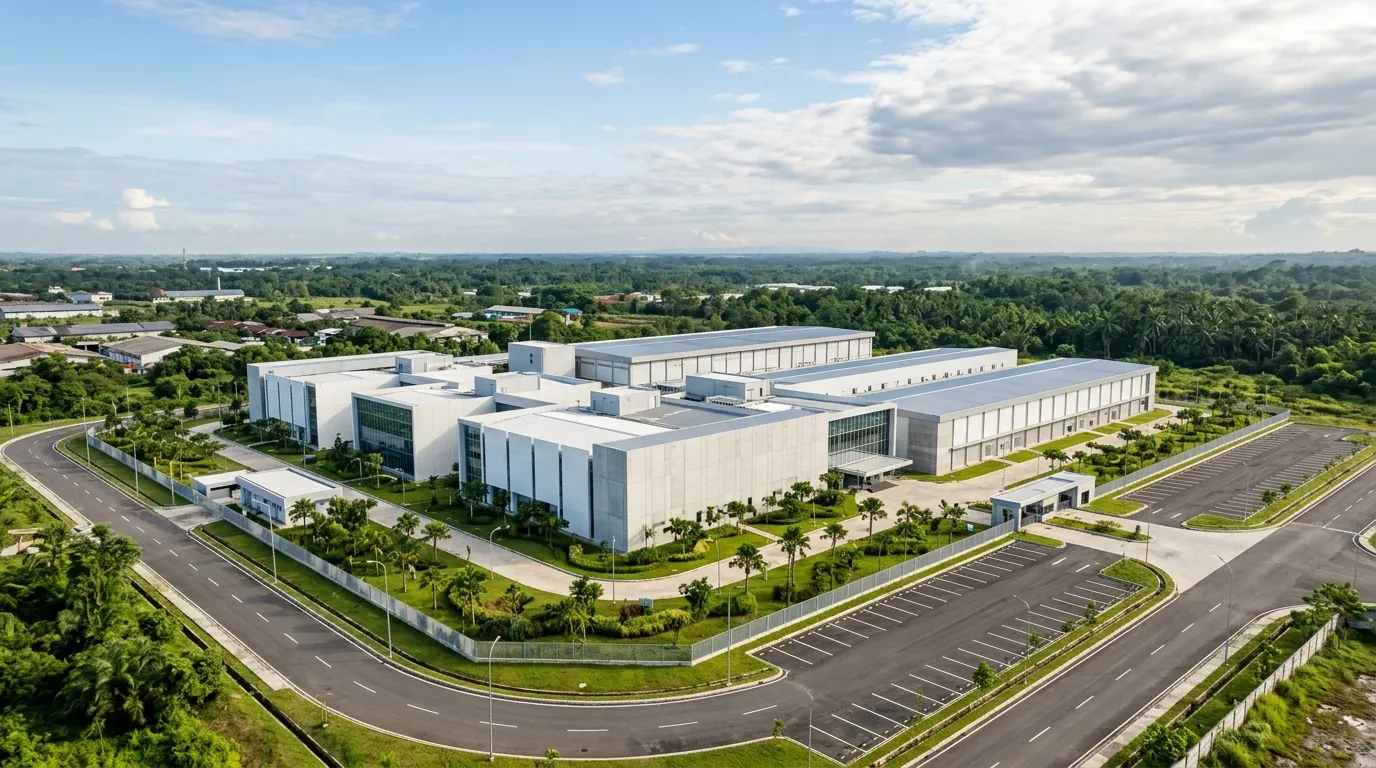
Manufacturing depth is real. Indonesia has operated an export-oriented metal fabrication industry for over four decades. Cable management specifically — cable tray, cable ladder, cable trunking — is manufactured by a cluster of factories in Tangerang, Bekasi, and Cikarang (all within the Greater Jakarta industrial corridor). The volume justifies serious tooling investment: roll-forming lines, hot-dip galvanizing tanks, powder-coat booths, and in-house load testing rigs. You are not buying from a trading company reselling commodity stock; you are buying from factories with genuine process control.
USD pricing is more stable. Indonesia’s cable management export market prices in USD. While the Rupiah (IDR) does fluctuate, factory costs are partially IDR-denominated — which means Rupiah depreciation episodes can be neutral or mildly favourable to USD buyers. China’s export pricing is also USD-denominated but is exposed to both CNY/USD moves and commodity price swings (hot-rolled steel coil in China tracks global demand more aggressively than local Indonesian production).
The Vendor Pre-Qualification Checklist
Not every Indonesian cable management factory is the same. Before writing an RFQ, run suppliers through this checklist:
1. ISO 9001:2015 certification (active) Request the full certificate, not just a logo. Check the issuing body (BSI, TÜV, SGS, Bureau Veritas are the most common for Indonesian manufacturers), the scope statement (it must cover cable management fabrication, not just a head office), and the expiry date. An expired or pending-renewal certificate is a yellow flag; understand what lapsed and why.
2. Sucofindo NEMA VE 1 load test report This is the key quality signal for Singapore-spec cable tray. The NEMA VE 1-2017 standard specifies load-deflection performance for cable trays — a Sucofindo (Indonesian state inspection body) third-party test to this standard gives you a Singapore-legible performance certificate. Ask for the actual test report number, the date, the specific tray sizes and spans tested, and the deflection results. METOSU’s Sucofindo NEMA VE 1 reports cover the full range — report E26929/FNBPAS for cable ladder (1,340 kg/span, NEMA Class 8C, tested 14 July 2025) and E26933/FNBPAS for cable tray (420 kg/span, NEMA Class 8B, tested 14 July 2025). Both reports were issued 18 July 2025 and are available on request.
3. SNI (Standar Nasional Indonesia) certification SNI is Indonesia’s national standard. For cable trays and cable ladders, SNI certification confirms the product meets the local mandatory standard and implies a factory audit trail. SNI-certified product is also easier to clear through Indonesian export customs. Confirm the SNI certificate number covers the specific product codes in your BOM.
4. Factory inspection (virtual or in-person) Request a factory walkthrough — virtual is acceptable for a first pass. You want to see: roll-forming lines and their condition, raw material storage (check for corrosion on coil stock), welding fixtures, the galvanizing or coating line, and the QC/inspection station. A factory that will not show you the production floor is a factory to skip.
5. Sample order before bulk commitment Order one container-worth of your exact specification — section profile, finish (hot-dip galvanised and/or powder-coat), hole pattern, load class — and conduct a full load test on arrival before releasing the main order. This is standard practice and any serious manufacturer will accept it. Factor in 4–6 weeks for a custom-spec sample.
6. Capacity verification Ask for m/month output for your specific section and finish. A factory that can ship 50,000 m/month of standard hot-dip galvanized tray may only produce 5,000 m/month of your specific custom perforated profile. Get the committed capacity allocation in writing before signing the PO.
7. Payment terms (LC vs T/T) Standard Indonesian export payment is 30% deposit on PO confirmation, 70% balance against B/L copy — either by T/T or LC at sight. For first orders with an untested supplier, LC at sight is prudent: the bank verifies documents before funds release. Trusted accounts move to T/T, which saves 1–2% in bank charges. Get the full commercial terms in the contract, not just email exchange.
Logistics: What Surprises Singapore Buyers
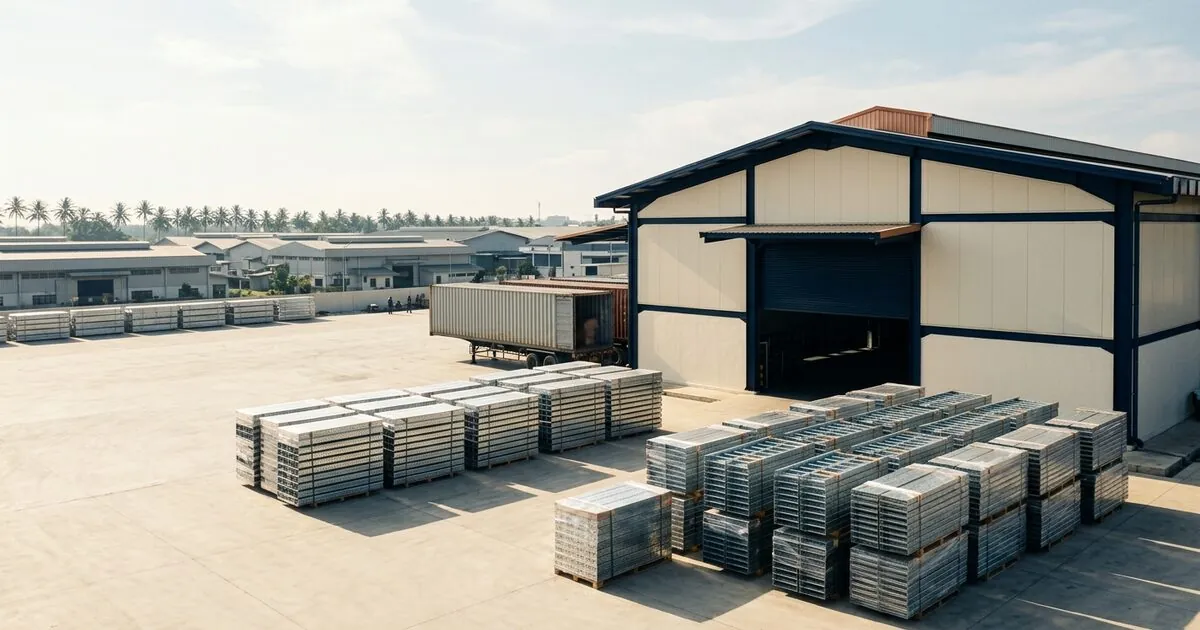
Container selection for cable tray Cable tray comes in 2.4 m, 3 m, 4 m, and 6 m lengths. Standard 20’ containers have an internal length of ~5.9 m — 6 m pieces require a 40’ container. A 40’ High Cube (9’6” internal height, ~12 m internal length) allows double-stack loading for shorter lengths and significantly increases payload utilisation. Most Tangerang factories are experienced with 40’ HC loading and will optimise stacking to maximise kg/TEU. Under-utilised containers are your cost — confirm packing diagrams before the load.
Singapore customs labelling Products entering Singapore must carry country of origin marking, HS code-aligned product description, and manufacturer name and address. ATIGA Form D (Certificate of Origin) must be issued by the Indonesian Chamber of Commerce or BKPM-authorised body before shipment and presented to Singapore Customs for preferential tariff treatment. Your freight forwarder should be familiar with this — if they are not, change forwarders.
Singapore electrical equipment standards Cable management is passive infrastructure — it does not itself require Singapore Safety Mark (SS Mark) or EMA type approval. However, if you are working on a project where the supervising consultant requires compliance with SS 2:2005 (the Singapore wiring standards) or data centre projects with EMA licensing requirements, confirm with the project EE/C&S consultant whether the cable tray load rating documentation (NEMA VE 1 or equivalent) needs to be submitted as part of the permit package. This is a project-specific question, not a product question — but it affects which test reports you need in your O&M manual.
Lead-Time Benchmarks
This is where Indonesia versus China is most concrete:
| Category | METOSU (Tangerang) | Typical China Supplier |
|---|---|---|
| Standard sizes (hot-dip) | Confirmed in the quotation | 6–10 weeks |
| Custom finishes (non-standard coating or profile) | Confirmed in the quotation | 8–14 weeks |
| Large project allocation (full project BOM, multi-container) | Confirmed in the quotation | 10–16 weeks |
| Transit to PSA (Singapore) | 3–5 days | 10–16 days |
| Total landed (standard sizes) | Production time in the quotation, plus transit | ~8–14 weeks |
The transit advantage compounds with the production lead time. For a Singapore DC contractor running a 12-week fit-out, ordering from Indonesia, where transit is days rather than weeks, can bring your cable management in weeks ahead of an import order, which is the difference between installing ahead of other trades and being the critical path.
All METOSU product is made to order. Send the BOM and we confirm the production and shipping schedule in the quotation.
Quality Assurance Protocol
Pre-shipment inspection (PSI) Request a PSI for every first order and for large-volume repeat orders. PSI options for Indonesian shipments include SGS, Bureau Veritas, Intertek, and TÜV Rheinland — all have Jakarta/Tangerang offices. A standard PSI for cable management covers dimensional check, finish check, load test sample (per NEMA VE 1 or agreed specification), and packing/labelling audit. Budget SGD 800–1,200 per inspection day.
Third-party witness testing For critical data centre projects, you can request that the factory’s production QC load test be witnessed by a third party (SGS or Bureau Veritas witness service). This upgrades the Sucofindo factory certification to a project-specific witnessed test result — stronger document for project O&M submission.
Site arrival check On delivery, pull a random sample — typically 1–2% of pieces — and run a visual check for finish damage, dimensional compliance, and punch pattern accuracy. For load-rated applications, retain one full test piece per size class and conduct a site-arrival load test using the project EE/C&S specified methodology. Document pass results before installation sign-off.
Payment and Commercial Terms
Standard for Singapore–Indonesia supply:
- Deposit: 30% on PO confirmation (T/T or LC deposit)
- Balance: 70% against shipping documents (B/L copy + Packing List + Invoice + Sucofindo NEMA VE 1 or equivalent + SNI cert + ATIGA Form D)
- Currency: USD is strongly preferred for Singapore buyers. IDR pricing is available but exposes you to Rupiah volatility; USD pricing transfers that risk to the seller, which is where it belongs.
- LC at sight: For first orders, request LC at sight with a Singapore bank (DBS, OCBC, UOB are all active in Indonesia trade finance). It adds 0.5–1.0% in bank charges but gives you full document verification before funds release.
- T/T for trusted accounts: After 2–3 successful orders, most Indonesian manufacturers will accept T/T 70% balance against B/L copy by email — which is faster and cheaper than LC.
- Incoterms: FOB Tanjung Priok is standard, giving you freight and insurance control. CIF Singapore is available from most suppliers but gives them freight selection, which sometimes means slower or less reliable feeders.
Risks — Named Honestly
Rupiah volatility USD/IDR moves within a 10–15% annual band in volatile years. If you are pricing a project in SGD but your Indonesian supplier has not fully hedged their IDR cost exposure, spot Rupiah depreciation can create pressure on their margin — which sometimes surfaces as quality shortcuts on subsequent orders. The hedge: price contracts in USD with a fixed-price validity window (60–90 days), and build supplier relationship depth so you hear about cost pressure before it becomes a quality problem.
Port congestion at Tanjung Priok Tanjung Priok is Indonesia’s busiest port and experiences congestion episodes — typically Q4 (pre-Christmas retail peak) and around Ramadan/Eid (March–April window). Lead times can extend by 1–2 weeks during peak congestion. For time-sensitive project deliveries, plan your PO 2 weeks earlier than your baseline lead time calculation during those periods. Your freight forwarder’s Jakarta office should be able to give you a live berth-wait indicator.
Regional holiday calendar Indonesian factories operate at reduced capacity during:
- Eid al-Fitr (Lebaran): 10–14 days closure, typically late March–May (shifts yearly). Production queues back up 2–3 weeks before and after.
- Chinese New Year (Lunar New Year): Some Tangerang factories have significant ethnic Chinese management and also reduce capacity, though less universally than Eid.
- Independence Day (17 August): Minor disruption, usually 1–3 days.
Build a holiday buffer into any annual procurement calendar. Factories will quote around the closures if asked, but you need to ask.
METOSU’s Specific Position
METOSU is a cable management manufacturer founded over 40 years ago, with its factory in Tangerang, Banten — inside the Greater Jakarta industrial corridor, approximately 30 km from Tanjung Priok port. The full product range covers cable tray, cable ladder, and cable trunking, in hot-dip galvanised and Jotun powder-coated finishes.
Trust signal — third-party verified: Sucofindo NEMA VE 1 load test reports cover the full cable tray and cable ladder range (E26929/FNBPAS, E26933/FNBPAS, both 14 July 2025), and SNI certification covers the cable tray and ladder product lines. Cert and report reference numbers are available on request from the SG account team.
For Singapore specifically, METOSU operates a dedicated Singapore-account engineering function: a specifier engineer who knows data centre project requirements, is familiar with EMA licensing submissions, and can provide NEMA VE 1 load documentation formatted for SG project O&M manuals. This is not a general sales function — it is a technical resource for contractor procurement teams evaluating cable management for regional DC projects.
METOSU’s Singapore route quote includes logistics pre-built: FOB Tanjung Priok with recommended Singapore freight forwarder partners, indicative transit cost, and ATIGA Form D documentation checklist. You are not reverse-engineering logistics from scratch.
Next Step: Request a Singapore-Route Quote
If you are at the RFQ stage — or building toward one — the fastest path is a conversation with METOSU’s Singapore-account team. They can return:
- Pre-qualification documentation (Sucofindo NEMA VE 1 reports, SNI certs, factory profile)
- Current lead-time and stock status for your specific BOM
- FOB Tanjung Priok pricing with logistics estimates to PSA
- ATIGA Form D documentation process outline
- Commercial terms (deposit, balance, currency, LC vs T/T)
Request a Singapore-route quote — with logistics and payment terms pre-built. →