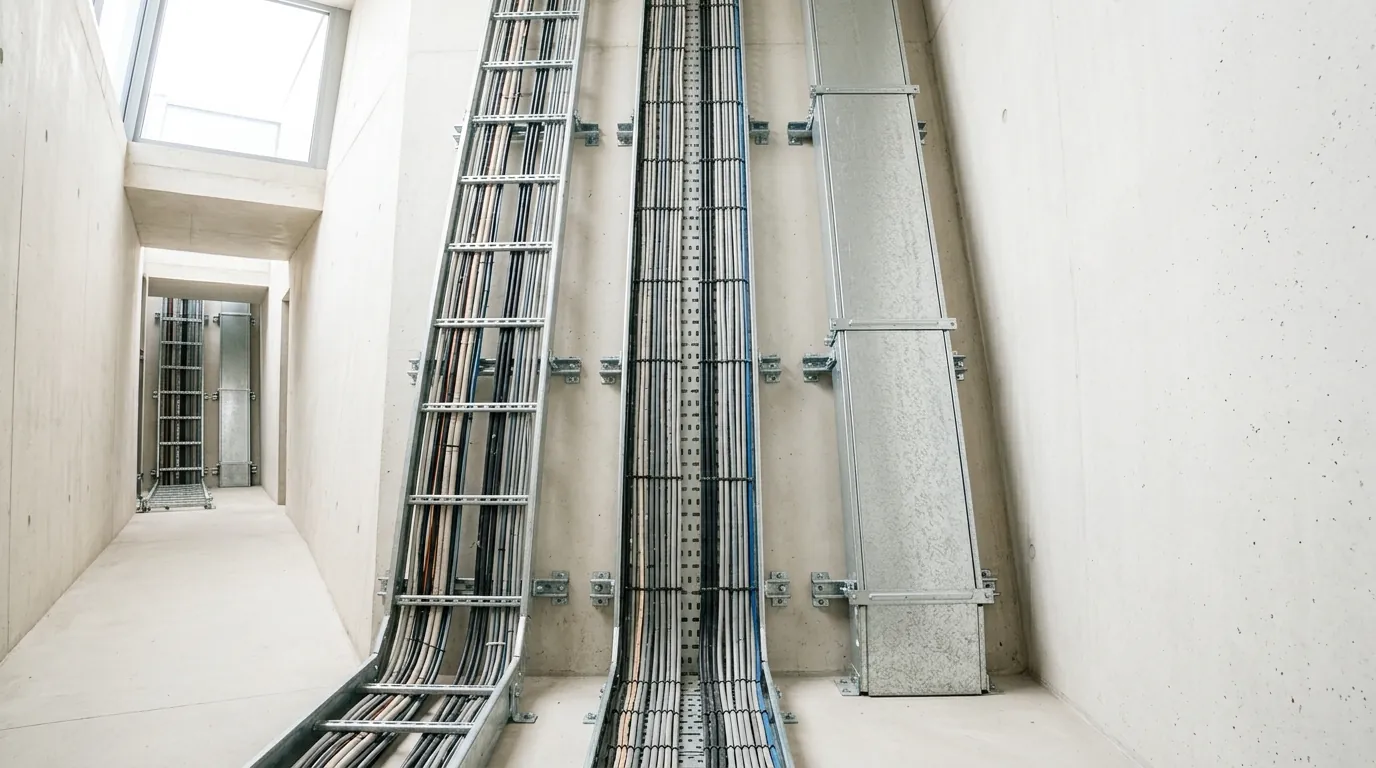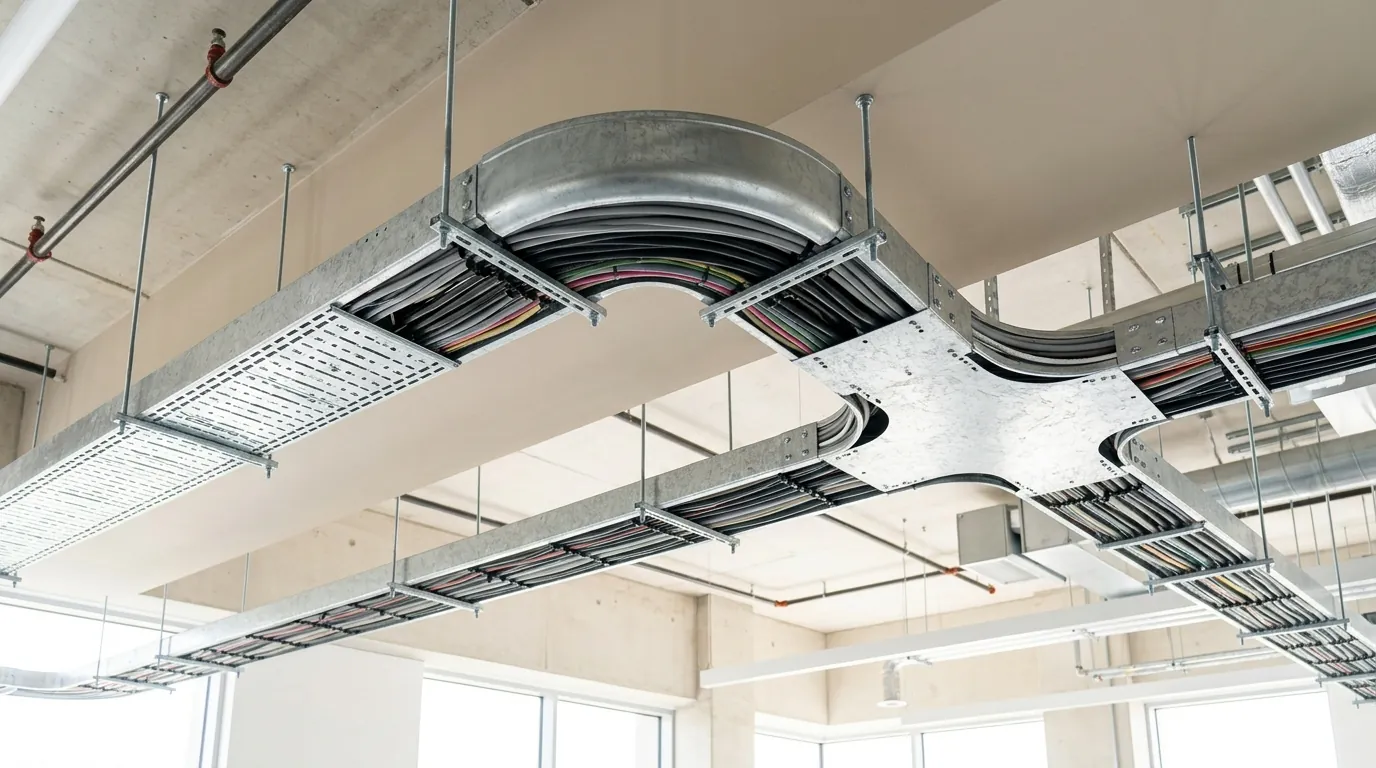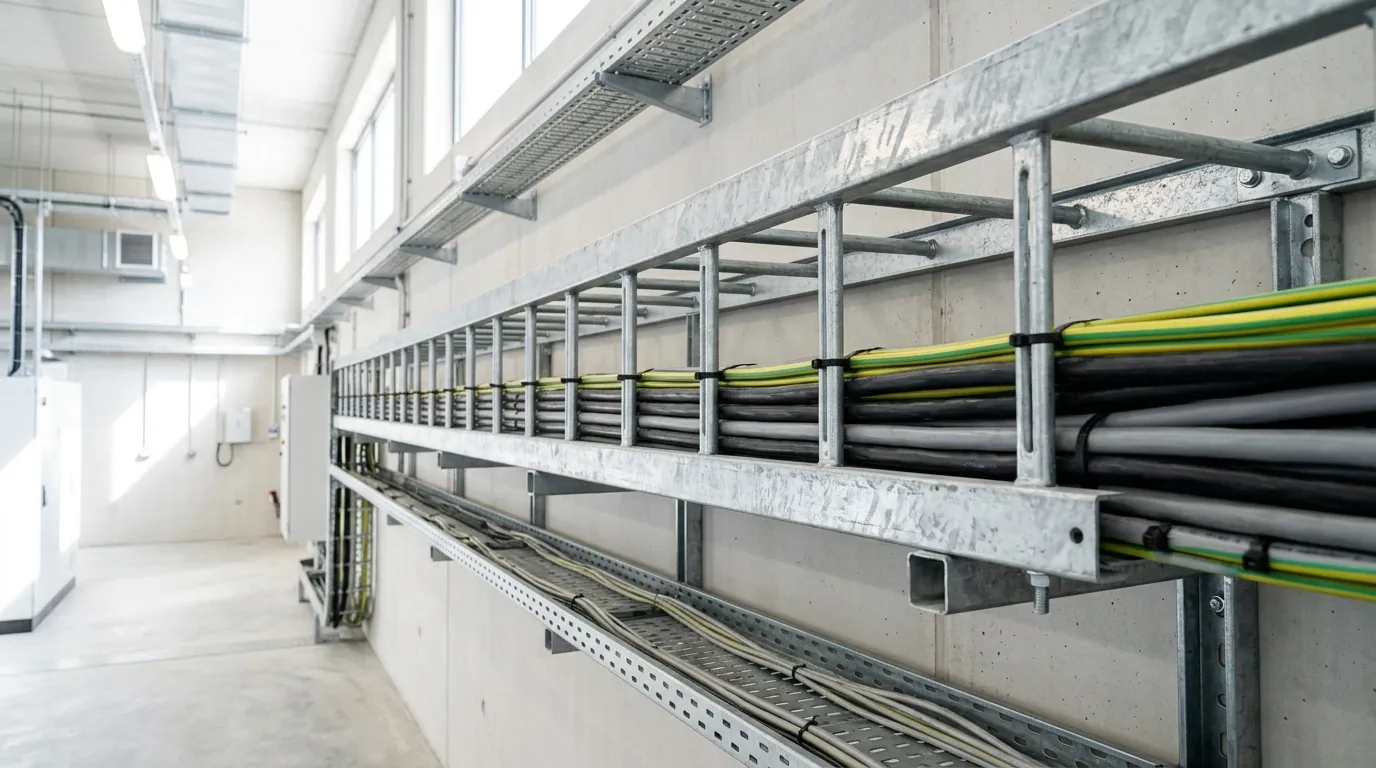
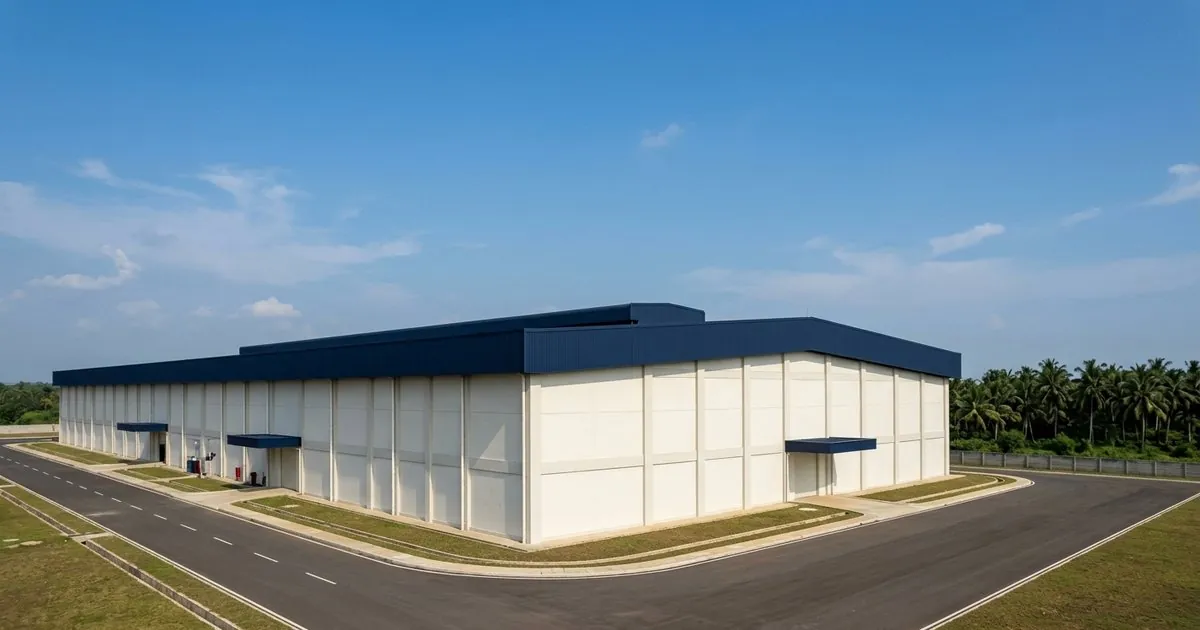
Single-storey hyperscale-format data hall in West Java daylight — the build profile this guide is written for. Cable management spec covered: NEMA VE 1 Class 8B cable tray (420 kg / 2,400 mm span, Sucofindo report E26933/FNBPAS) and Class 8C cable ladder (1,340 kg / 2,400 mm span, Sucofindo report E26929/FNBPAS, 18 July 2025) — manufactured at PT Metosu Anugrah Perkasa’s Tangerang factory.
If you are writing a cable tray specification for a hyperscale data centre build in Indonesia, you can source NEMA VE 1–rated product from a local Indonesian manufacturer without accepting a certification gap. PT Metosu Anugrah Perkasa holds Sucofindo-issued NEMA VE 1 certification for cable tray (report E26933/FNBPAS) and cable ladder (report E26929/FNBPAS), with load tests conducted at the Sucofindo laboratory in July 2025. Local manufacture delivers in 4–6 weeks from purchase order from the Tangerang factory; equivalent imported product from China or Malaysia runs 12–16 weeks CIF Tanjung Priok.
This guide covers the four specification axes for hyperscale cable management, METOSU’s dual NEMA + SNI certification path, seismic derating requirements under SNI 1726:2019, a local-versus-import operational comparison, and a vendor pre-qualification checklist.
1. How to Specify Cable Tray for Hyperscale: The Four Axes
Cable tray for a hyperscale data centre is not a commodity selection. Four parameters govern the specification.
Step 1 — Load Class (NEMA VE 1)
NEMA VE 1-2017 defines cable tray load performance in terms of uniformly distributed load per unit length at a rated span. The standard is performance-based: it prescribes deflection and yield criteria at each load class, not steel thickness or section geometry.
Cable tray — Sucofindo report E26933/FNBPAS (NEMA VE 1-2017/CSA C22.2)
The tested section is METOSU cable tray TRU W 300 × H 100 × L 3000 (base thickness 2.02 mm), at a 2,400 mm span. Verbatim load–deflection data from the report:
| Load (kg) | Deflection (mm) | Note |
|---|---|---|
| 0 | 0 | — |
| 100 | 2 | — |
| 200 | 4 | — |
| 300 | 8 | Deflection maximum (limit: 9.6 mm per 1:250 × 2,400 mm) |
| 400 | 13 | — |
| 420 | — | Sample damaged |
Verbatim from E26933/FNBPAS: “Actual received load = 420 kgs per span. Class 8B = minimum load 403 kg must no damage to sample.” The cable tray section meets NEMA Class 8B at a 2,400 mm span. For 600 mm-wide tray used on hyperscale main cable routes, contact the METOSU design-assist team for the load-class rating on the wider section and your specific span.
Cable ladder — Sucofindo report E26929/FNBPAS (NEMA VE 1-2017/CSA C22.2)
The tested section is METOSU cable ladder SLU W 600 × H 100 × L 3000 (base thickness 1.95 mm), at a 2,400 mm span. The load table in E26929/FNBPAS records progressive deflection through 1,300 kg with no specimen failure — the certificate confirms NEMA Class 8C at 1,340 kg per span. The 600 mm-wide cable ladder is the primary product for inter-rack data centre routing where cable fills routinely exceed 100 kg/m at 3 m support centres.
A 600 mm-wide tray serving 8–12 hyperscale racks at a 3 m support span routinely carries 40–80 kg/m of cable fill under steady-state conditions, with higher instantaneous loads during initial commissioning pulls. Undersizing the load class by one step produces mid-span deflection of 6–12 mm at full load — sufficient to close bend-radius clearance on adjacent fittings and complicate conduit-seal inspections in a live facility.
Step 2 — Span
Both METOSU’s cable tray (E26933/FNBPAS) and cable ladder (E26929/FNBPAS) are tested at a 2,400 mm span under NEMA VE 1-2017. Standard commercial DC installations in Indonesia run cable tray at 1.5–2 m support centres. Hyperscale builds following TIA-942 Tier III methodology often extend to 3 m spans to reduce structural ceiling penetrations and simplify raised-floor routing.
For 6 m spans — used where floor penetrations are structurally constrained — de-rate working load using the NEMA VE 1 span-rating methodology. The full de-rating table is in METOSU’s technical datasheet; the design-assist team will confirm values for your IFC layout on request.
Step 3 — Bend Radius
Cable manufacturer datasheets and general installation practice set minimum bend radii for cables installed in trays: 8× cable OD for optical fibre bundles, 10× OD for cables rated above 1 kV, and 15× OD for armoured categories. A 4 × 240 mm² (4 × 477 kcmil) LV feeder cable with an OD of approximately 55 mm requires an 825 mm minimum inside bend radius at horizontal tray elbows. METOSU supplies horizontal and vertical bends, tees, and reducers in 100–600 mm widths with standard inside radii of 300 mm, 450 mm, and 600 mm, matched to the same hot-dip galvanised coating specification (ISO 1461) as the straight sections.
Step 4 — Select Finishing per Environment (ISO 12944)
Cable tray for Indonesian hyperscale builds is typically specified in hot-dip galvanised finish (ISO 12944 C3 indoor or C4 where condensation risk applies) or Jotun powder coating at 60–80 µm for internal environments requiring RAL colour-coding. Fire-stopped penetration collars at floor slabs and firewalls are a separate BOQ line item.
Note: Cable tray is a structural support system, not a fire-resistant enclosure — NEMA VE 1 does not test fire resistance. Fire separation of cable runs is handled through compartmentation, conduit selection, or cable type (typically LSZH to IEC 60332-3 Category C or A for Indonesian hyperscale builds).
Step 5 — Issue RFQ to a Dual-Standard Manufacturer
For Indonesia-based builds, specify a manufacturer who holds simultaneous NEMA VE 1 and SNI certification — detailed in Section 2 — and can provide Sucofindo test reports for AVL onboarding. See the pre-qualification checklist in Section 5.
2. NEMA + SNI Dual Certification
Singapore-trained MEP consultants writing specifications for Indonesian builds default to NEMA VE 1 load classes, the most widely cited cable tray performance standard in the Asia-Pacific data centre sector. The concern when listing an Indonesian manufacturer on an approved vendor list (AVL) is certification traceability: is the NEMA VE 1 rating backed by independent test data, or is it a self-declaration?
The NEMA VE 1 path. METOSU’s cable tray and cable ladder are tested and certified through PT Sucofindo — the Indonesian state surveying, testing, and inspection body — to NEMA VE 1-2017/CSA C22.2 methodology. Reports E26933/FNBPAS (cable tray, Class 8B, 420 kg per 2,400 mm span) and E26929/FNBPAS (cable ladder, Class 8C, 1,340 kg per 2,400 mm span) document the full test setup, loading protocol, deflection measurements, and yield thresholds. Testing was conducted at 26.7°C, 68% humidity; specimens were physically loaded and witnessed by Sucofindo engineers in July 2025. These reports are available to MEP consultants during pre-qualification. PT Sucofindo operates under KAN accreditation (Komite Akreditasi Nasional, Indonesia’s national accreditation body), making a Sucofindo NEMA VE 1 report equivalent in traceability to one issued by SGS or Bureau Veritas — independent, third-party, physically witnessed testing.
The SNI path. Indonesian-manufactured cable tray that meets NEMA VE 1 load performance simultaneously satisfies the relevant Standar Nasional Indonesia (SNI) requirements covering dimensional tolerances, base-metal thickness, surface treatment, and structural load performance. SNI certification is issued through the Badan Standardisasi Nasional (BSN) framework. A single manufactured product can carry both NEMA VE 1 certification (from a Sucofindo test report) and SNI marking — standard practice for Indonesian manufacturers serving the regional data centre market.
Practical consequence. A specification section that reads “cable tray to NEMA VE 1, Class 8B” is satisfied by METOSU’s locally manufactured product without a substitution request or consultant derogation. The same product simultaneously satisfies the SNI requirement for Indonesian regulatory submissions — one vendor, two compliance frameworks, no import logistics.
For a deeper treatment of how NEMA VE 1 and SNI interact at the standard level, see the companion post: NEMA VE 1 vs SNI: Cable Tray Standards for Indonesian Projects.
3. Seismic Derating: Indonesia-Specific Requirements
Indonesia’s position across the Indo-Australian, Eurasian, and Pacific plate boundaries produces seismic hazard among the highest in Southeast Asia. The governing national standard is SNI 1726:2019 — Indonesia’s seismic design code, aligned with ASCE 7-16 in scope — with site-specific Spectral Acceleration (S_a) values published by the Pusat Studi Gempa Nasional (PuSGeN).
Zone-by-zone implications for cable tray support spacing:
- Jakarta–Karawang corridor (primary hyperscale zone): SNI 1726:2019 Site Class D is typical; Peak Ground Acceleration (PGA) ranges 0.15–0.30g. Non-structural seismic design per SNI 1726:2019 Section 13 requires braced-hanger supports and reduces maximum unbraced cable tray hanger spacing from the standard 3 m to 1.8 m for trays carrying fills above 20 kg/m. Horizontal seismic bracing is required at 6 m intervals.
- West and Central Kalimantan (emerging DC corridor): PGA < 0.10g in most areas. Standard NEMA VE 1 support spacing applies, subject to site-specific geotechnical input.
- Sulawesi and Eastern Indonesia: PGA 0.30–0.50g in the Palu–Makassar corridor. SNI 1726:2019 Section 13 seismic force calculations reduce support spacing to 1.2–1.5 m for cable trays wider than 300 mm; braced-frame support systems are required.
Documentation an MEP consultant needs for IFC drawings:
- Steel grade and yield strength for the cable tray base material — required to confirm SNI 1726:2019 ductility demands are met.
- Hanger bracket pull-out ratings matched to the structural slab being used, per SNI 1726:2019 Section 13 horizontal force calculations.
- Seismic anchor bolt pattern and minimum embedment depth — a civil coordination item, but the tray manufacturer must confirm hanger baseplate compatibility.
- Engineering data for lateral load performance — NEMA VE 1 tests vertical load only; seismic horizontal forces are additive. Request test data or a PE-stamped calculation for the lateral case from any manufacturer you shortlist.
METOSU’s design-assist service produces the above documentation package for Indonesian builds at no cost for specified projects. Contact the specification team at /en/contact with the site’s SNI 1726:2019 site class designation and intended support system (dropped hanger, strut channel, or trapeze), and receive a support design within 5 working days.
4. Local vs Import: Operational Comparison
For a hyperscale build with a compressed civil completion schedule — typical for Indonesian greenfield builds targeting a 12–18 month fit-out cycle — cable tray lead time regularly lands on the critical path.
| Parameter | PT Metosu Anugrah Perkasa (Tangerang) | Import — China or Malaysia |
|---|---|---|
| Lead time, standard sizes | Confirmed in the quotation | 12–16 weeks CIF Tanjung Priok |
| Lead time, specials (bends, custom widths) | Confirmed in the quotation | +4–6 weeks on top of standard |
| On-site engineering support | Yes — design-assist, site visits from Tangerang | Remote only |
| Warranty administration | In-country | Return to origin |
| Spare parts replenishment | Confirmed in the quotation | 8–12 weeks import cycle |
| Certificate traceability | Sucofindo reports E26933/FNBPAS + E26929/FNBPAS held locally; available for audit at 24 hours’ notice | Third-party report held via import agent |
| SNI compliance | Native certification | Requires Indonesian import certification review |
For a 10–20 MW hall requiring 2,500–4,000 linear metres of cable tray, local manufacture reduces procurement risk materially. A 4-week supply disruption on cable tray delays cable pulling, which delays commissioning, which delays commercial operation date. See the broader sourcing picture in: Sourcing Cable Management from Indonesia: A Guide for Singapore Contractors.
5. Vendor Pre-Qualification Checklist
Before adding any cable tray manufacturer to the approved vendor list for an Indonesian hyperscale project, request the following:
- NEMA VE 1 test report from an accredited or government-recognised laboratory — current (within 5 years), covering the specific load class and tray width you will specify. For METOSU: E26933/FNBPAS (cable tray, Class 8B, 420 kg per 2,400 mm span) and E26929/FNBPAS (cable ladder, Class 8C, 1,340 kg per 2,400 mm span).
- ISO 9001:2015 quality management certificate — verify the scope covers cable tray manufacture, not only the parent entity.
- Material traceability — per-heat steel test certificates from the last production batch, confirming base-metal specification (grade, yield strength, coating weight per ASTM A123).
- Factory audit — inspect the roll-forming line, galvanising or coating process, and QC sampling procedure. METOSU’s Tangerang factory (Jatake Industrial Estate) accepts pre-qualification visits; contact /en/contact to arrange a schedule within 2 business days.
- Load test sample — request a 600 mm × 3 m tray section for in-house load verification at your rated class. Standard practice for projects exceeding 1,000 linear metres.
- Design-assist scope — confirm the manufacturer can deliver seismic coordination documentation, support-layout drawings, and BOQ-ready dimensional tables for your IFC submission. METOSU’s design-assist service is included at no cost for specified projects. See current projects for reference installations.
Specify Local, Specify to Standard
PT Metosu Anugrah Perkasa manufactures cable tray and cable ladder to NEMA VE 1-2017 (Class 8B and 8C), Sucofindo-certified, at 4–6 weeks lead time from the Tangerang factory (Jatake Industrial Estate, Tangerang, Banten). The same product carries SNI certification — one approved vendor satisfying both the international specification and the Indonesian regulatory requirement simultaneously.
For BOQ-ready dimensional tables, Sucofindo report copies (E26933/FNBPAS and E26929/FNBPAS), and design-assist support for seismic coordination on your Indonesian build:
Request a hyperscale-grade quote — design-assist available for hyperscale builds in Indonesia.
Related: Cable Tray · Cable Ladder · Data Centre Projects · NEMA VE 1 vs SNI Comparison · Sourcing Guide for SG Contractors